The science of probiotics demands precision. In collaboration with leading scientists and research partners from around the world, we develop research-backed probiotics for outcomes across gastrointestinal, dermatological, oral, pediatric, and nutritional health.
For humans, by science.
Our process starts with microbial strain validation through biofermentation, stabilization, scale-up, and clinical research.
Strains

Probiotic Strain Validation
Our strain bank consists of probiotic strains with extensive mechanistic and clinical data generated at academic institutions and research partners around the world—including Italy, Spain, Belgium, US, and Japan. Our strains are deposited in the American Type Culture Collection (ATCC).
Research-Derived Dosage
We select our strains based on robust clinical and mechanistic research, and preserve the biologically active dose of each strain in our product. Further, we ensure that the full dosage of live and active bacteria is delivered at or above label claim throughout the entire shelf life and under even the most destructive shipping temperatures.
Biofermentation
Biofermentation
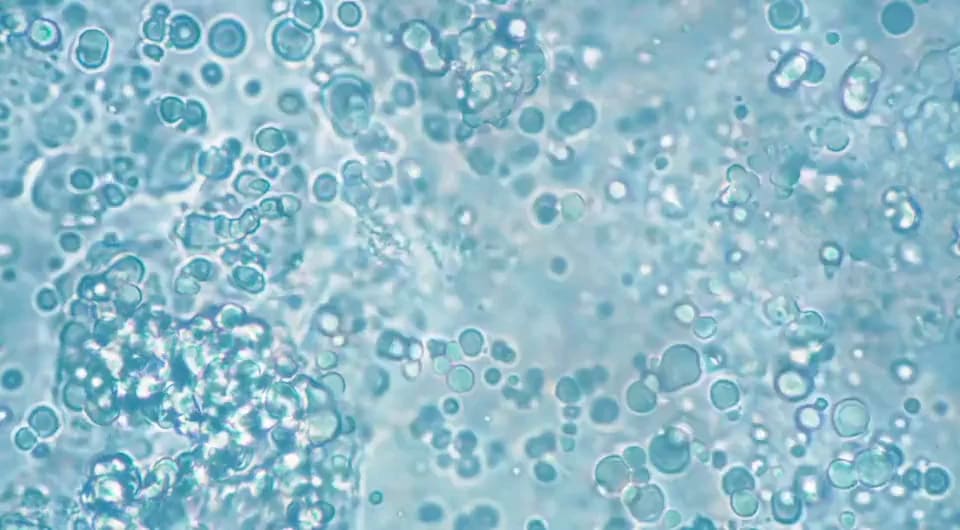
This—a metabolic process used by bacteria to generate energy for cell growth and multiplication—is how we culture our probiotic strains. Bacteria are sensitive. They must be cultured with care to ensure viability. We optimize biofermentation conditions for pH, strain purity, temperature, and 28 other factors.
Validation

Flow Cytometry
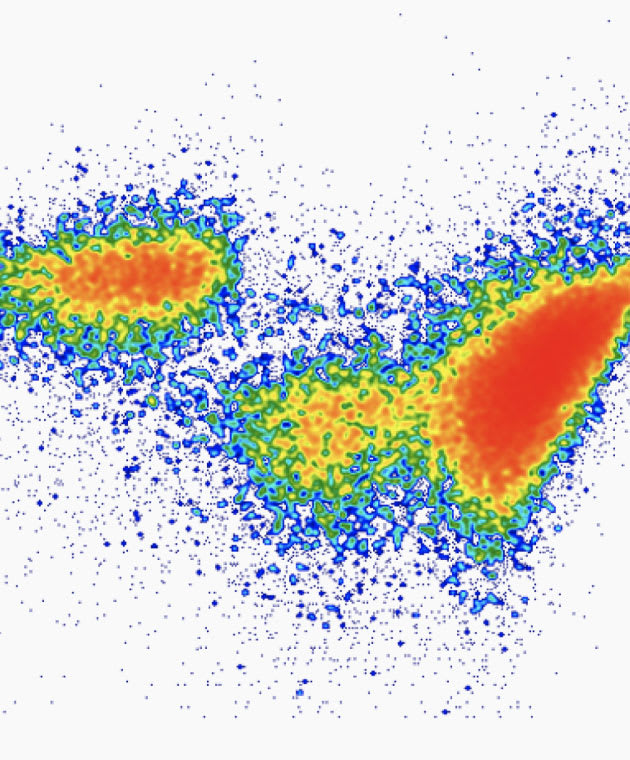
During this process, cells are selectively tagged with fluorescent "markers" and counted by a laser as they pass through a tube. In testing for AFU (Active Fluorescent Units), flow cytometry is used to calculate a more precise measurement of all viable, injured, and dead probiotic cells, including ones that are efficacious but not necessarily culturable (and therefore, would not be counted in a traditional plated colony forming units (CFU) measurement—what you’re probably used to seeing on probiotics labels).

Whole-Genome Sequencing
Our probiotics are among the first to undergo end-to-end, whole-genome testing—the application of nanopore and shotgun sequencing of microbial DNA to genetically validate each strain and species.
Clinical Research
We partner with leading academic research institutions and notable Primary Investigators to validate our rationally-designed probiotic formulations through double-blind, randomized, placebo-controlled clinical trials. Our human clinical work, in combination with strain-specific clinical research and our in vitro data generation, allows us to identify novel endpoints and benefits for human health, while contributing advancements to the fields of microbiome and probiotic science.
SHIME®
Simulator of the Human Intestinal Microbial Ecosystem (SHIME®)
Bacteria are fragile; they’re sensitive to heat, oxygen, light, water, and they don’t do well without protection from stomach acids or bile. With this in mind, we test our products in SHIME®, the closest system developed to model human digestion and the gut.

Fig. 3 — To evaluate the survival of our probiotics, we use a Simulator of the Human Intestinal Microbial Ecosystem (SHIME®)—the closest system developed to model digestion and the gut. It recreates the physiological conditions and biological processes (food uptake, peristalsis, digestive enzymes, bile acids, and time spent in each step) representative of the human gastrointestinal tract.


Our Scientific and Clinical Advisory Boards
Our Scientific and Clinical Advisory Boards consist of scientists and clinicians across key fields, including microbiology, computational biology, host-microbe interactions, immunology, gastroenterology and women’s health. They lead labs, teach at world-renowned academic institutions, maintain regular patient-facing practices, and include members who serve as investigators from the NIH’s Human Microbiome Project. These scientists and clinicians have produced 2800+ publications and over 140,000 citations in peer-reviewed scientific journals and textbooks.


Gregor Reid, PhD, MBA

Jacques Ravel, PhD

George Church, PhD

Belinda Tan, MD, PhD

James Versalovic, MD, PhD

Alessio Fasano, MD

Sarkis Mazmanian, PhD

Christopher Mason PhD
Peter Turnbaugh, PhD

Eran Segal, PhD

Jessica Alligretti, MD, MPH

Jane van Dis, MD

Uma Naidoo, MD

Emeran Mayer, MD

Susan Kellogg-Spadt, PhD, CRNP, IF, CDC

Mark Hyman, MD

Diane Harper, MD, MPH, MS

Nick Van Hise, PharmD
Microbes for the future, and for our Earth.





As the earliest inhabitants of this planet, microbes hold immense potential for our future. Beyond their impact as consumer probiotics, their applications range from living medicines that transform how we prevent and treat disease to environmental interventions that will address some of the most pressing challenges facing our collective home.
Learn about SeedLabs

Approach
SHIME®
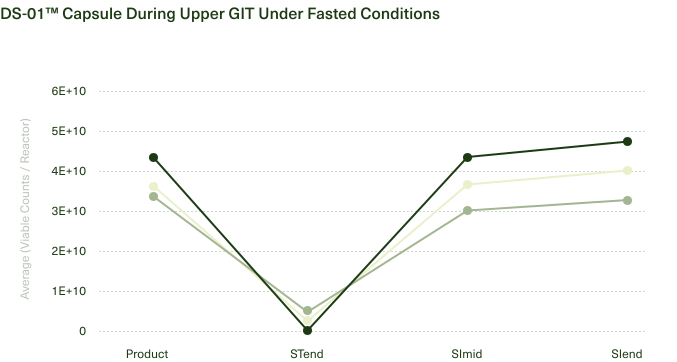
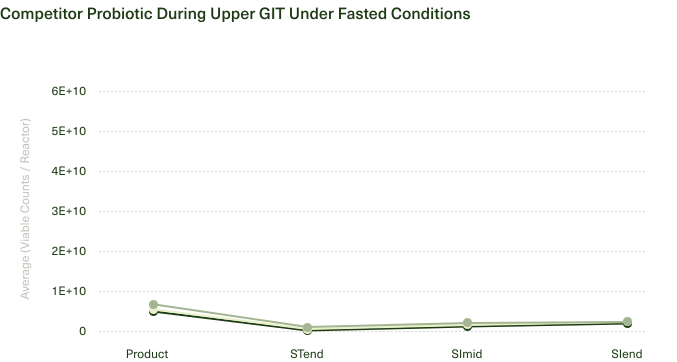
At the three-hour mark of incubation, the ViaCap® capsules were fully dissolved and delivered a maximal release of living probiotics—maintaining the full value of the starting dose (10.57 log vs 10.60 log, or about 100%), indicating viability through the end of the small intestine.
Approach
Strain Taxonomy- Genus
- Species
- Strain
Approach
Diversity, Equity + Inclusion in Clinical ResearchDiversity, Equity and Inclusion in Clinical Research
The underrepresentation of minority groups in clinical trials has contributed to egregious gender and racial data gaps and significant systemic disparities in care.
Beyond what is imperative—that all persons, regardless of sex, race, age, gender identity, or sexual orientation deserve acknowledgement in the field of scientific research—diversity in clinical trials is essential.
We commit to the inclusion of a broad representation of identities and experiences in all aspects of our clinical research to enrich the biological, ethnocultural, and linguistic diversity of our study population, the applicability of the research findings, and to foster inclusiveness in clinical research and equity in health.
- Our Commitments
- Set diversity recruitment targets.
- Remove enrollment barriers—geography, transportation costs, multilingual materials and scheduling—through partnerships with tech-enabled trial platforms.
- Recruit a diverse range of physicians and hospital staff at trial sites to ensure cultural awareness and multilingual resources.
- Utilize technology and social media to recruit remotely when possible and to increase reach of enrollment efforts.
- Ensure accessibility considerations for products, treatments, and education.